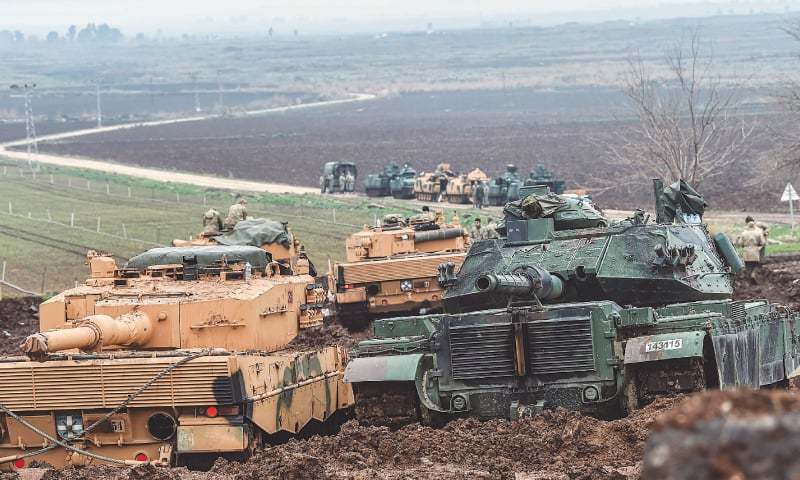
 WASHINGTON: After Turkey assaulted a relatively peaceful
Kurdish enclave of northern Syria, regional leaders fear the world will
abandon them even though they provided the ground troops who beat the
militant Islamic State group.
WASHINGTON: After Turkey assaulted a relatively peaceful
Kurdish enclave of northern Syria, regional leaders fear the world will
abandon them even though they provided the ground troops who beat the
militant Islamic State group.
For the past four days,
Turkish troops and allied Arab Islamist fighters have been battling
their way into Syria’s Afrin canton, which is defended by the
American-backed Kurdish YPG militia.
US leaders,
including President Donald Trump, have appealed for restraint, but
appear to have little influence over their Nato ally when it comes to
its battle against the Kurds.
Now the Kurds, whose
unofficial national motto admits they have “no friends but the
mountains”, fear they will be the forgotten victims as Turkey, Russia
and the United States manoeuvre for influence.
And this
despite providing the backbone of the US-backed Syrian Democratic Forces
(SDF) who gifted Trump his first military victory — the fall of the IS
capital, Raqa.
Sinam Mohamed, chief envoy of the “Rojava
self-ruled Democratic Administration” which runs several cantons in the
Kurdish-majority north of Syria, said she fears for her family in Afrin.
“For us, the United States has a moral obligation to protect the democracy in this area,” Mohamed told reporters in Washington.
For
local leaders, the self-ruled Rojava area is an experiment in
democratic federalism that could serve as an example for the rest of
Syria to follow as it emerges from civil war.
But Turkey
sees the Kurdish-led regions of northern Syria as a supply corridor for
“terrorists” and a rear base for the banned PKK movement, which has
waged a three-decade insurgency in the Turkish southeast and is
blacklisted as a terror group by Ankara and its Western allies.
Mohamed
insisted “not a single bullet” had been fired from Afrin towards Turkey
and that if Turkey has a problem with the PKK it is a domestic issue
and not a cross-border one.
More than 2,000 US special
forces backed by air power work with the Kurdish YPG, under the banner
of the SDF east of the Euphrates to fight the IS.
But the
YPG in Afrin, an isolated pocket west of the river, have no overt US
military backing and — after Syria’s ally Russia apparently gave Turkey
the green light to attack — they are under siege.
In the
YPG-controlled area on the other bank of the Euphrates but still exposed
to the long Turkish frontier, fighters are increasingly bitter about
the US role.
“The Kurds fought Daesh, to defend the whole
world, they coordinated with the US-led coalition,” said Omar Mahmoud, a
35-year-old civilian, using the Arabic acronym for IS. “Now the US is
silent, and it’s disappointing.”
Comments
Post a Comment